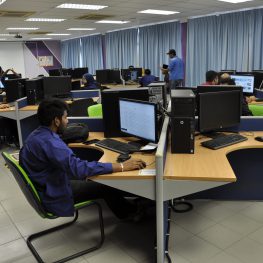
The pioneer batch students of the current Diploma programs (DET in Ship Design and DET in Ship Construction and Maintenance) had graduated in June 2007. It is expected that some will take up employment in the industries and some who attain good grades will have the opportunity to continue their study to a higher level. A Bachelor degree program of combined specializations is being planned to cater the requirement of these prospective students. The Government of Malaysia seeks to strengthen the capacity and the capability of the shipbuilding and repair sector under the Third Industrial Master Plan (IMP3) from 2006 to 2020. This is necessary as to reduce the outflow of capital for the acquisition of marine transport products, especially ships. The push to the shipbuilding and repair sector is amongst the strategic thrusts for the long-term growth and viability of the marine transport sector. In order to support and materialize the national industrial perspective in the marine transportation sector, sufficient number of professionals in the combined fields of specializations (naval architecture and shipbuilding) and others are necessary to be produced. Also, in line with the vision of UniKL it is timely for the university to train and develop technical entrepreneurs in the combined specializations of Naval Architecture and Shipbuilding to be able to participate in the relevant activities of the marine industries.
Admission Intake
January and September
Admission Requirements
Pass in STPM/Matriculation/Foundation or its equivalent, with minimum CGPA 2.00 and at least Grade C in Mathematics and one relevant Science subject; OR
Pass in International Baccalaureate (IB) with at least 24 points; OR
Pass in A-Level with minimum Grade D in Mathematics one (1) relevant Science subject; OR
Pass in Sijil Tinggi Agama Malaysia (STAM) with minimum grade of Jayyid and pass SPM or its equivalent with minimum Grade C in Mathematics and one relevant Physical Science subjects (i.e; Physic, Chemistry & etc); OR
Recognized Diploma in Engineering/Engineering Technology or its equivalent with CGPA 2.00; OR
Recognized related Technical/Vocational/Skills Diploma with CGPA 2.00; OR
Pass Diploma Kemahiran Malaysia (DKM)/ Diploma Lanjutan Kemahiran Malaysia (DLKM)/ Diploma Vokasional Malaysia (DVM) with a minimum CGPA of 2.50 and the programme must get Full Accreditation (FA) by MQA or others Accreditation bodies that had been recognized by government of Malaysia and according to approval by UniKL Senate; OR
Pass the DKM/DLKM/DVM with a minimum CGPA of 2.00 AND have at least two (2) years of work experience in the related field. The programme must get Full Accreditation (FA) by MQA or others Accreditation bodies that had been recognized by government of Malaysia and according to approval by UniKL Senate
Programme Educational Objectives (PEOs)
The Bachelor of Naval Architecture and Shipbuilding (Hons) graduates, two to five years into their careers:
PEO 1: Knowledgeable, competent and innovative in the field of naval architecture and shipbuilding.
PEO 2: Have effective leadership and teamwork skills as well as verbal, non-verbal and interpersonal communication skills to support their role in industry.
PEO 3: Committed towards the importance of lifelong learning and continuous improvement.
PEO 4: Professional, ethical and socially responsible.
PEO 5: Capable of embarking on business and technopreneurial activities.
Programme Learning Outcomes (PLOs)
Upon graduation, our students of Bachelor of Naval Architecture and Ship Building with Honors – BNASB will be able to:
PLO1 Knowledge: Apply knowledge of mathematics, natural science, computing and engineering fundamentals and an engineering specialization as specified in SK1 to SK4 respectively to defined and applied engineering procedures, processes, systems or methodologies.
PLO2 Problem analysis: Identify, formulate, research literature and analyse broadly-defined in Engineering Technology problems reaching substantiated conclusions using analytical tools appropriate to their discipline or area of specialisation with considerations for sustainable development; (SK1 to SK4)
PLO3 Design/development of solutions: Design solutions for broadly-defined Engineering Technology problems and contribute to the design of systems, components or processes to meet identified needs with appropriate consideration for public health and safety, whole-life cost, net zero carbon as well as resource, cultural, societal, and environmental considerations as required. (SK5)
PLO4 Investigation: Conduct investigations of broadly-defined Engineering Technology problems; locate, search and select relevant data from codes, databases and literature, design and conduct experiments to provide valid conclusions. (SK8)
PLO5 Tool Usage: Select and apply, and recognize limitations of appropriate techniques, resources, and modern engineering and IT tools, including prediction and modelling, to broadly-defined engineering technology problems ; (SK2 and SK6)
PLO6 The Engineering Technician and the World: Analyze and evaluate sustainable development impacts to: society, the economy, sustainability, health and safety, legal frameworks, and the environment, in solving broadly-defined Engineering Technology problems. (SK1, SK5, and SK7)
PLO7 Ethics: Understand and commit to professional ethics and norms of engineering technology practice and adhere to relevant national and international laws. Demonstrate an understanding of the need for diversity and inclusion. (SK9)
PLO8 Individual and Collaborative Team Work: Function effectively as an individual, and as a member or leader in diverse and inclusive teams and in multi-disciplinary, face-to-face, remote and distributed settings. (SK9)
PLO9 Communications: Communicate effectively and inclusively on broadly defined engineering activities with the engineering community and with society at large, by being able to comprehend and write effective reports and design documentation, make effective presentations, taking into account cultural, language, and learning differences.
PLO10 Project Management and Finance: Apply knowledge and understanding of engineering technology management principles and economic decision-making to one’s own work, as a member and leader in a team and to manage projects in multidisciplinary environments.
PLO11 Life Long Learning: Recognize the need for, and have the ability for i) independent and life-long learning and ii) critical thinking in the face of new specialist technologies; (SK8).
Modules
SEMESTER
SUBJECTS
Semester 1
Penghayatan Etika dan Peradaban*
Bahasa Melayu Komunikasi 2**
Fundamental English
Engineering Mathematics 1
Maritime Law
Statics and Dynamics
Engineering Drawing
Occupational Safety and Healty
*For local students only
**For international students only
Semester 2
Falsafah dan Isu semasa*
Philosophy and Current Issues**
Foreign Language 1
Workshop Technology
Professional English 1
Marine Materials Structure
Engineering Mathematics 2
Naval Architecture 1
*For local students only
**For international students only
Semester 3
Foreign Language 2
Electrical and Electronic Principles
Inter of Thins (IoT) Technology
Mechanics of Materials
Professional English 2
Naval Architecture 2
Thermodynamics
Innovation Management
Semester 4
Fluid Mechanics
Ship Structure
Computational Analysis for Engineering
CAM Technology
Computer Aided Marine Design 1
Kursus Integriti dan Anti-Rasuah 2
Isu-isu Kontemporari Muslim di Malaysia***
Culture and Lifestyle in Malaysia****
***For local Muslim students only
****For local non Muslim and international students only
Semester 5
Co-Curriculum 2
Ship Production Technology
Seakeeping and Maneuvering
Ship Resistance and Propulsion
Computer Aided Marine Design 2
Marine Machinery
Semester 6
Final Year Project 1
Ship Design
Marine System Design
Ethics for Technologist
Marine Project Management
Semester 7
Quality Management
Technopreneurship
Final Year Project 2
Elective 1
Elective 2
Semester 8
Industrial Training
Additional Module
Bahasa Kebangsaan A
Electives
Integrated Marine Pollution Control
Oceanography
Cargo Handling System
Fundamentals Maritime Operation
Maritime Economics and Transportations
Principle of Communication System
Electrical Machines
Asset Integrity Management
Foreign Language
Mandarin 1
Arab Language 1
French 1
Italian 1
Korea Language 1
Spanish 1
Russian 1
Mandarin 2
Arab Language 2
French 2
Italian 2
Korea Language 2
Russian 2
Spanish 2
Co-Curriculum 2
Career Guidance 2
Community Service 2
Culture 2
Rakan Masjid 2
Siswa siswi Bomba & Penyelamat 2
Kor Siswa siswi Pertahanan Awam 2
Sports Management 2
Personal Financial Management 2
Askar Wataniah
Contact Us
UNIVERSITI KUALA LUMPUR Malaysian Institute of Marine Engineering Technology (UniKL MIMET) Dataran Industri Teknologi Kejuruteraan Marin, Bandar Teknologi Maritim, Jalan Pantai Remis, 32200 Lumut, Perak Darul Ridzuan, MALAYSIA.